
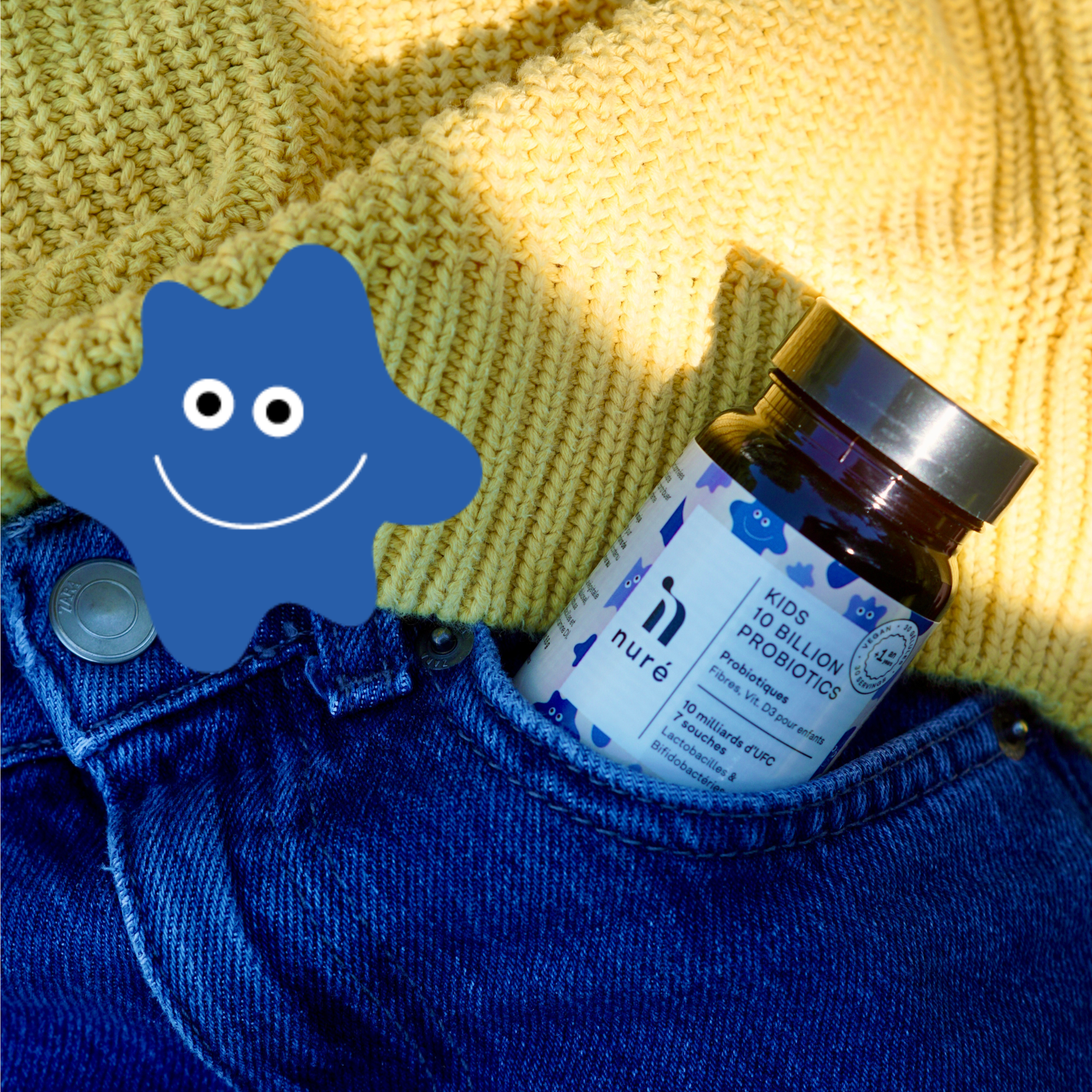
According to the Biocodex Microbiota Observatory, only 32% of French people know precisely what the microbiome is. Yet it influences your child's immunity, digestion, and even mood every single day.
You hear more and more about the microbiome these days. But what does it actually mean for your child? And why does it matter more during childhood than at any other time in life?
Your child's gut microbiome influences their immunity, their digestion, their sleep, their mood, and even their ability to concentrate at school. And the window to build it well is much shorter than most people think.
In this guide we cover: what the microbiome is, how it builds from birth, how to recognise when it needs support, and what to do to protect it day to day.
What is the gut microbiome and why does it matter so much in children?
The gut microbiome is the community of billions of bacteria living in your child's intestine. Far from being harmful, the vast majority of these bacteria are essential to their health.
In children, the microbiome plays three fundamental roles:
Digestion: it breaks down nutrients from food and makes them available for the body to absorb and use.
Immunity: the gut-associated lymphoid tissue (GALT) concentrates approximately 70% of the body's immune cells. From the first months of life, the gut microbiome plays a central role in educating this system: it teaches immune cells to tolerate what is harmless and to respond to what is threatening. A diverse, balanced microbiome is therefore one of the pillars of a child's immune development.
Protection: the gut microbiome plays an active protective role. By occupying sites on the intestinal lining and producing antimicrobial substances, it limits the proliferation of pathogenic bacteria. This role is particularly critical in young children, whose intestinal barrier is still maturing and whose microbiome is still being built during the early years of life.
What makes childhood so critical is the timing. The microbiome begins building from birth and reaches a relative stability around age 3 to 4. The quality and diversity of the microbiome established during this window has consequences that extend throughout a child's entire life. The good news: it can always be supported and improved, whatever your child's age.
What recent research tells us
In November 2025, INRAE and AP-HP launched Le French Gut Kids: the first national French research project dedicated to mapping the gut microbiome of children and adolescents aged 3 to 17. The project aims to collect samples from 10,000 children by 2029.
Until recently, very little was known about what actually happens in a child's gut. French scientists are only now beginning to map it for the first time. The project will specifically study how diet, lifestyle, and environment shape microbiome diversity during childhood and adolescence: exactly the period when chronic conditions, including allergies, obesity, and digestive disorders, are increasing most rapidly in young people.
This is the most significant French research initiative on children's gut health currently underway. It confirms what pediatric nutritionists observe in practice every day: what happens in your child's gut during childhood matters far more than was previously understood.
The first 1,000 days: a crucial but not irreversible window
You may have heard of the concept of the "first 1,000 days": from conception to age 2. This period is recognised as particularly important for microbiome construction. The mode of delivery, breastfeeding, the environment, and early food choices all shape the foundations of your child's gut health, with effects lasting a lifetime.
But here is what matters: this is not a window that closes and locks. The microbiome continues building, evolving, and responding to care throughout childhood and adolescence. Regardless of how your child was born, whether they were breastfed or not, and whatever antibiotic courses they may have had: their microbiome can always be nourished, diversified, and strengthened. It is never too late to start.
How to tell if your child's microbiome needs support
A disrupted microbiome does not always announce itself loudly. More often it shows up quietly, in things parents notice day to day but do not immediately connect to gut health.
The most common signs to watch for in children: your child catches every cold going around, even outside of winter. Their stomach hurts regularly, especially in the mornings or before school. Their skin breaks out in eczema or reactive patches that keep coming back. Their transit is irregular: constipated one week, loose stools the next. They seem more tired, more irritable, or more anxious than usual without a clear reason.
If several of these are present at the same time and have been going on for a while, the microbiome is worth looking at. It is rarely the first place parents think to look, but it is often where the answer is. The AFPA confirms that microbiome imbalance in children is more common than people think and increases with the number of antibiotic courses received.
6 factors that damage your child's gut microbiome
Understanding what harms the microbiome is just as important as knowing what builds it. Several modern habits quietly deplete your child's microbial diversity every day.
1. Ultra-processed food
Diets rich in refined sugars, additives, and poor-quality fats while being low in fibre impoverish bacterial diversity and favour opportunistic bacteria. When reading food labels, the shorter the ingredient list, the better. Be cautious of any ingredient beginning with E followed by a number, refined sugar in any form, sweeteners, and poor-quality fats. In general, if you cannot identify all the ingredients on a label, the product is likely to be problematic for the microbiome.
2. Excess sugar
Sugar feeds undesirable bacteria, causing imbalance, bloating, and chronic low-grade inflammation. The most problematic forms are glucose-fructose syrup, white sugar, fructose syrup, and corn syrup. Watch for hidden sugars in breakfast cereals, biscuits, sweetened drinks, and flavoured yogurts: this is where the majority of hidden sugar accumulates in children's diets.
3. Repeated antibiotics and PPIs
Antibiotics are life-saving medicines but they do not distinguish between pathogenic and beneficial bacteria: they eliminate both. The consequences are a significant reduction in bacterial diversity, the disappearance of key strains, and a weakening of the gut's protective lining.
A study published in Nature Communications showed that certain microbiome changes can persist for several months after a single antibiotic course. A Harvard study also confirmed that antibiotic-related microbiome disruption in babies has measurable long-term consequences. This is precisely why actively supporting the microbiome during and after every antibiotic course makes such a meaningful difference: the sooner you act, the faster it recovers.
Proton pump inhibitors (PPIs), sometimes prescribed for infant reflux, can also affect microbiome balance. If your child has taken PPIs, supporting the microbiome with probiotics and prebiotic-rich foods is a simple and effective step.
4. Lack of fibre
Fibres are the fuel of the microbiome. They feed good bacteria and allow the production of short-chain fatty acids essential for gut health and immune function.
The formula to remember: your child's daily fibre needs equal their age plus 5 grams per day. A 5-year-old needs approximately 10 grams of fibre daily. A 9-year-old needs 14 grams. Most children in France do not reach this level. Constipation is often the first consequence of insufficient fibre intake in children.
5. Food additives
Certain emulsifiers, preservatives, and sweeteners alter microbiome composition and weaken the gut's protective lining. When reading labels, here is what to watch for: emulsifiers to limit are E466, E433, E471. Preservatives to limit are E211, E202, E250, E621.
6. Lifestyle factors
The microbiome is sensitive not just to what your child eats but to how they live.
Contact with nature: children who play regularly outdoors, in the earth, and with animals are exposed to a wider diversity of bacteria. This exposure supports the development of a diverse, resilient immune system.
Sleep: the microbiome follows the body's daily rhythm. Regular, good-quality sleep supports microbiome balance, and a healthy microbiome in turn supports better sleep.
Physical activity: movement supports a more diverse and resilient microbiome. Outdoor play, even 20 minutes a day, makes a meaningful difference.
6 foods that nourish your child's gut microbiome
Supporting your child's microbiome through food is both effective and accessible. These six foods are the most impactful.
1. Sauerkraut and fermented vegetables
Non-pasteurised sauerkraut is rich in live beneficial bacteria, particularly lactobacilli, which reinforce gut diversity. The key detail: non-pasteurised. Heat destroys the live bacteria that make fermented foods beneficial. Variants your child might accept: milder versions of kimchi, miso dissolved in soups, tempeh as a protein source.
2. Garlic and the prebiotic family
Garlic is rich in inulin, a type of fibre that feeds the good bacteria already present in the gut. It does not add bacteria itself: it feeds the ones already there. Variants with similar properties: onion, leek, asparagus, artichoke.
3. Jerusalem artichoke: the prebiotic powerhouse
Jerusalem artichoke is particularly rich in prebiotic fibres that specifically promote bifidobacteria, the beneficial bacteria most important during childhood. It also reduces pathogenic bacteria and directly supports transit regularity. Variants: chicory root, salsify.
4. Natural yogurt and kefir
Natural yogurt contains live bacteria that directly enrich the gut microbiome. The key detail: the yogurt must not be pasteurised after fermentation, as this kills the live cultures. Check the label for "contains live cultures."
Kefir is even richer: a fermented drink containing up to 10 different beneficial bacterial strains, it is one of the most potent natural probiotic foods available for children.
5. Slightly unripe bananas
Slightly unripe bananas contain resistant starch, a type of fibre that feeds beneficial gut bacteria. As bananas ripen, the resistant starch converts to sugar and the benefit decreases. The greener the banana, the stronger the effect.
6. Mushrooms, cranberry, and other allies
Certain mushroom varieties, particularly reishi, maitake, shiitake, and oyster mushrooms, contain compounds that support microbiome diversity and immune function.
Cranberry contains a non-digestible compound from the xyloglucan family that acts as a prebiotic and specifically promotes the growth of a beneficial Bifidobacterium strain: a lesser-known but particularly interesting ally for children.
Lentils provide both fibre and plant protein and directly support microbiome diversity. They are one of the most underrated foods for children's gut health.
| Food | Type | Key benefit | From what age |
|---|---|---|---|
| Natural yogurt | Probiotic | Enriches gut flora directly | 6 months |
| Kefir | Probiotic | Up to 10 different strains | 12 months |
| Non-pasteurised sauerkraut | Probiotic | Rich in lactobacilli | 12 months |
| Garlic, onion, leek | Prebiotic | Feeds existing good bacteria | 6 months cooked |
| Slightly unripe banana | Prebiotic | Resistant starch | 6 months |
| Jerusalem artichoke | Prebiotic | Boosts bifidobacteria | 12 months |
| Cranberry | Prebiotic | Supports Bifidobacterium specifically | 12 months |
Probiotics vs prebiotics: what is actually the difference?
These two words are often used interchangeably but they describe completely different things, and understanding the difference helps you make better choices for your child every day.
Probiotics are living bacteria: the good bacteria themselves. They help digest food, synthesise vitamins, fight harmful bacteria, reinforce natural defences, and protect the gut. You find them naturally in yogurt, kefir, non-pasteurised sauerkraut, and miso.
Prebiotics are fibres that the body cannot digest but that serve as food for the good bacteria. Without prebiotics, probiotic bacteria cannot establish themselves and stay active. You find them in slightly green bananas, garlic, onion, leek, apples, and whole grains.
Together they form what scientists call a synbiotic: a combination where the whole is greater than the sum of its parts. Think of it this way: probiotics are the seeds you plant in the garden, and prebiotics are the water and sunlight that make them grow and thrive. This is why a probiotic formula that also contains prebiotic fibres, like our Kids 10 Billion Probiotics, delivers significantly better results than probiotics alone.
According to the Canadian Digestive Health Foundation, targeted probiotic supplementation can reduce the duration of acute diarrhoea by 20 to 30% in children.
| Probiotics | Prebiotics | |
|---|---|---|
| What they are | Live bacteria | Indigestible fibres |
| What they do | Add beneficial bacteria | Feed existing bacteria |
| Where to find them | Yogurt, kefir, sauerkraut, miso | Banana, garlic, oats, leek |
| Together | Synbiotic effect: significantly more powerful than either alone |
Diarrhoea and the microbiome: what parents need to know
Diarrhoea in children is one of the most common signs that the gut is under stress, whether from a viral infection, a dietary change, or an antibiotic course. It is the body's way of signalling that gut balance needs support.
The right actions during a diarrhoea episode: hydration first, with water, clear broths, or rehydration solutions such as those recommended by your pharmacist. This is the priority before anything else.
Gentle foods that support recovery include rice, cooked carrots, banana, grated apple, and steamed potato. These foods are gentle on the stomach, help stools become more regular, and do not irritate the gut.
Supporting gut flora is essential: probiotics, particularly bifidobacteria, help restore the gut barrier and reduce the duration of diarrhoea episodes. Starting child-appropriate probiotics on the first day can meaningfully shorten recovery time.
What to avoid during and after the episode: fatty, sugary, or ultra-processed foods. These feed disruptive bacteria and slow recovery.
If diarrhoea lasts more than 2 to 3 days or your child seems unwell, consult your paediatrician.
The gut-brain axis: how your child's gut affects their behaviour
The intestine is often called the "second brain," and for good reason. Via the gut-brain axis, a direct communication channel between gut and brain, the microbiome directly influences serotonin production, emotional regulation, and attention capacity. Approximately 95% of the body's serotonin is produced in the gut.
A balanced microbiome means a calmer and more concentrated child. This is why children with digestive discomfort are often also more irritable, more anxious, or struggle to focus at school. The connection is not coincidental: the gut and brain are in constant conversation.
Emerging research suggests the microbiome may also play a role in neurodevelopmental challenges like ADHD via this gut-brain connection. Certain probiotic strains, particularly Lactobacillus helveticus, Bifidobacterium longum, and Lactobacillus rhamnosus, are being studied for their potential to support mood regulation, stress reduction, and attention in children. This research is still emerging and probiotics do not replace usual medical treatment. Always discuss with your doctor before using probiotics as a complement to any medical treatment for your child.
When and how to give your child probiotics
Probiotics are beneficial year-round but certain moments deserve particular attention.
During and after antibiotics, this is the most important use case. Start probiotics on day 1 of antibiotic treatment and space the intake by at least 2 hours from the antibiotic dose. Continue for at least 1 month after the course ends, or 2 months if the course lasted more than 7 days.
During repeated fatigue, colds, or convalescence, when your child keeps catching every virus, the microbiome is often a factor. A targeted probiotic cure supports the immune system's natural defences.
At back to school in September, the start of the school year can be a challenge for the gut: new bacteria, stress, rhythm change. A September preventive cure with Bifidobacterium longum and Bifidobacterium infantis, combined with acacia prebiotic fibres, helps reinforce your child's first line of defence before winter viruses arrive. Ideal duration: the entire month of September.
From the youngest age, from 1 year, a probiotic formula adapted to children supports the microbiome during its most critical development phase and can help reduce colic and mild digestive discomfort.
A 3-month cure helps the body find its natural balance gradually and durably. Punctual support, during antibiotics or at back to school, is shorter and more targeted. The two approaches serve different purposes and complement each other.
How to choose a probiotic for your child
The number of strains: most children's probiotics contain 2, 3, or 4 strains. A formula with 7 different complementary strains provides broader action across immunity, digestion, and transit.
The CFU count: CFU (Colony Forming Units) measures live bacteria per dose. 400 million is insufficient. 1 billion is modest. 10 billion per dose is the level that delivers meaningful results.
Zero additives: most probiotic powders are up to 90% fillers and additives. The bacteria and prebiotic fibres should be the formula, nothing more. Zero sugar, zero additives, zero maltodextrin.
The capsule format: the capsule guarantees bacterial survival through heat and humidity. A capsule that opens easily and mixes into water or yogurt means no additives are needed to make it palatable for young children.
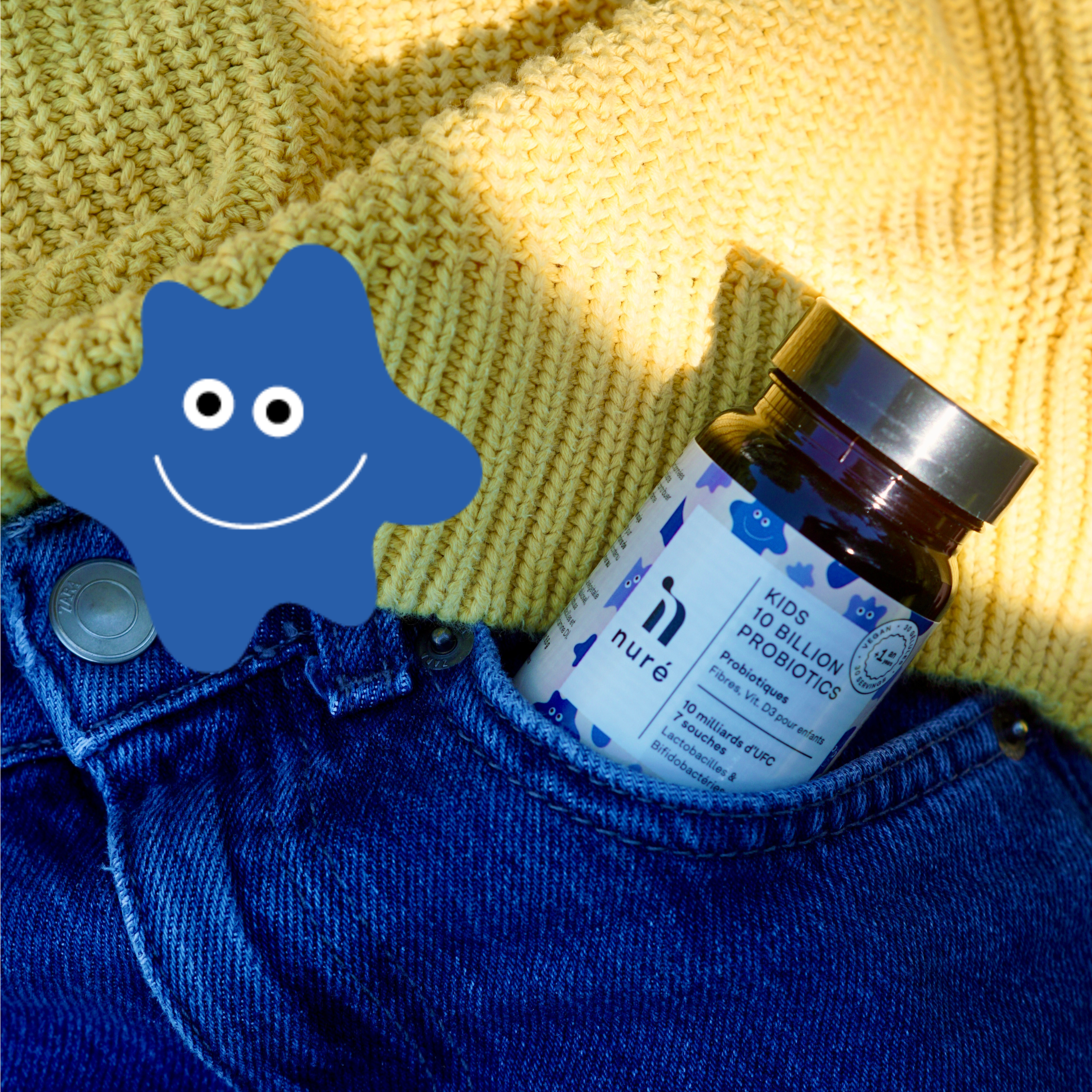
Our Kids 10 Billion Probiotics bring together all of these criteria: 7 carefully selected strains, 10 billion CFU per capsule, acacia prebiotic fibres included, zero sugar, zero additives, zero maltodextrin. From 1 year.
Your daily checklist to support your child's microbiome
These are the habits that make the biggest cumulative difference, applied consistently every day:
At least one portion of fibre-rich food at every meal: vegetables, legumes, whole grains, fruits with skin.
At least one prebiotic food daily: garlic or onion in cooking, slightly green banana as a snack, oat flakes at breakfast.
One fermented food daily if possible: natural yogurt at breakfast or as a snack, kefir as a drink.
Sufficient hydration: water as the primary drink, adapted to age (1.2 to 1.6 litres per day).
Outdoor play, even 20 minutes a day, meaningfully supports microbiome diversity.
A consistent bedtime routine: regular sleep supports microbiome balance.
During and after every antibiotic course: start probiotics on day 1, space by 2 hours, continue 1 to 2 months after.
Frequently asked questions
From what age can I give my child probiotics?
From 1 year for most children's probiotic supplements. For babies under 1 year, specific infant probiotics exist. Always check the product's age recommendation and consult your paediatrician.
Can probiotics be given every day?
Yes. Probiotics are not medicines: they are living bacteria that support the gut's natural balance. A 3-month daily cure supports gradual microbiome rebalancing. Shorter targeted courses address specific situations: antibiotics, back to school, frequent illness.
Do supermarket yogurts contain real probiotics?
Only if they contain live cultures not heat-treated after fermentation. Look for "contains live cultures" on the label. Flavoured yogurts and those with a long shelf life have often been pasteurised after fermentation: the bacteria are no longer alive.
How many strains should a good children's probiotic contain?
At least 5 to 7 complementary strains targeting immunity, digestion, and transit. A formula with 7 strains including Bifidobacterium lactis, Bifidobacterium longum, Lactobacillus acidophilus, Lactobacillus gasseri, Lactobacillus plantarum, Lactobacillus rhamnosus GG, and Lactobacillus reuteri covers the full spectrum of children's gut health needs.
What are the signs that my child's microbiome needs support?
The most common signs are frequent colds or infections, recurring stomach aches, irregular transit, persistent eczema, unexplained fatigue, and irritability or mood changes without a clear cause. If several of these are present at the same time over a period of weeks, the microbiome is worth supporting.
Can gut health affect my child's behaviour and concentration?
Yes. Via the gut-brain axis, the microbiome directly influences serotonin production and emotional regulation. Children with a disrupted microbiome are often more irritable, more anxious, and struggle more to concentrate. Supporting gut health is increasingly recognised as an important part of supporting children's mental and emotional wellbeing.
Should I give probiotics at back to school?
September is one of the most valuable moments for a probiotic cure. Back to school means massive exposure to new bacteria, stress, and rhythm disruption. A September preventive cure with Bifidobacterium longum and Bifidobacterium infantis combined with acacia prebiotic fibres helps reinforce the first line of defence before winter viruses arrive.
My child has had several antibiotic courses: is it too late to support their microbiome?
It is never too late. The microbiome is resilient and responds well to support at any age. Starting probiotics for children, increasing prebiotic-rich foods, and reducing sugar and ultra-processed foods will make a meaningful difference regardless of your child's history.
What parents should know
The gut microbiome builds primarily during the first years of life, but it can be supported, strengthened, and improved at any age.
70% of the immune system is located in the gut: a healthy microbiome is the foundation of your child's natural defences.
The signs that a microbiome needs support are often everyday observations: frequent colds, stomach aches, irregular transit, eczema, fatigue, and irritability. It is rarely the first place parents look, but it is often where the answer is.
Ultra-processed food, excess sugar, repeated antibiotics, lack of fibre, food additives, and too little outdoor time all deplete the microbiome.
Fermented foods (yogurt, kefir, sauerkraut), prebiotic-rich foods (garlic, banana, leek, cranberry), and fibre-rich foods (legumes, whole grains) are the most powerful daily dietary tools.
Probiotics and prebiotics work best together: this combination is called a synbiotic. A formula with 7 strains, 10 billion CFU per dose, prebiotic fibres, and zero additives delivers the most complete support. Discover our Kids 10 Billion Probiotics.
A 3-month cure supports gradual microbiome rebalancing. Targeted shorter cures address specific situations: antibiotics, back to school, frequent illness, digestive discomfort.
This article is written for informational purposes only and does not replace medical advice. Consult your paediatrician before starting any supplementation for your child.
Sources and further reading
All sources cited in this article are listed below with direct links so you can read them yourself.
INRAE and AP-HP: Le French Gut Kids, November 2025
https://www.inrae.fr/actualites/french-gut-kids-lancement-du-projet-explorer-microbiote-intestinal-jeunes-france
Nature Communications: long-term impacts of antibiotic exposure on the human gut microbiota
https://www.nature.com/articles/ncomms10410
Harvard Magazine: Harvard study shows how antibiotics disrupt babies' microbiomes
https://harvardmagazine.com/2016/06/harvard-study-shows-how-antibiotics-disrupt-babies-microbiomes
AFPA: the development of the microbiome during childhood
https://afpa.org/pediatre-en-ligne/le-developpement-du-microbiote-pendant-lenfance/
Biocodex Microbiota Observatory
https://www.biocodexmicrobiotainstitute.com/fr
Canadian Digestive Health Foundation: probiotics for children
https://cdhf.ca/fr/les-probiotiques-pour-les-enfants/